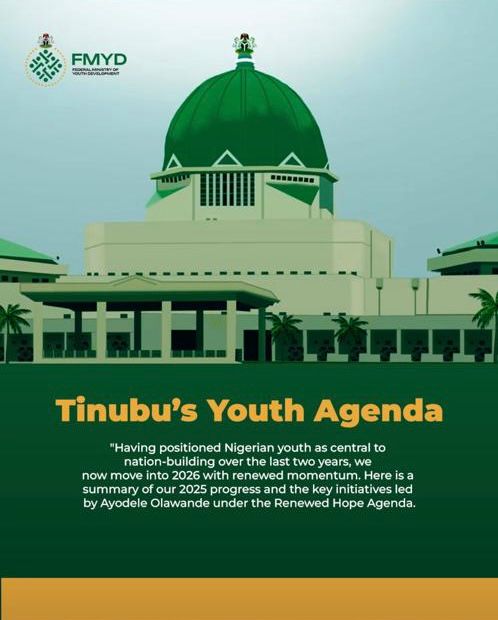
Over the last two years, the Renewed Hope Administration has made a deliberate and strategic decision: to place Nigerian youth at the very centre of national development and nation-building.
Under the leadership of the Honourable Minister of Youth Development, Comrade Ayodele Olawande, this commitment has moved beyond rhetoric into structured policies, coordinated programmes, and measurable outcomes that directly address the aspirations of young Nigerians.
As we transition into 2026, the focus is clear, consolidating gains, scaling impact, and ensuring sustainability.
This blog highlights key progress recorded in 2024-2025 and outlines how the Tinubu Administration continues to translate youth-focused policy into tangible opportunities under the Renewed Hope Agenda.
A Shift from Promises to Platforms
One of the defining features of the current youth agenda is the shift from fragmented interventions to system-based delivery. Youth development is no longer approached as isolated projects, but as interconnected pipelines spanning skills, employment, innovation, enterprise, and civic participation.
This approach recognizes that Nigeria’s youthful population is not just a demographic advantage, but a strategic national asset that must be intentionally developed.
Key Youth Development Milestones in 2025
1. Skills for the Future Economy
The Ministry prioritized large-scale skills development aligned with emerging sectors, including:
- Digital and technical skills
- Creative economy capacity building
- Automotive and clean energy value chains
- Entrepreneurship and business management
These initiatives are designed not only to improve employability but to prepare young people for jobs of the future, both locally and globally.
2. Access to Youth Financing and Enterprise Support
Recognizing that skills must be matched with capital and opportunity, the administration strengthened access to:
- Youth-focused funding windows
- Enterprise grants and loans
- Creative economy financing
- Business development and mentorship support
These interventions aim to reduce barriers that have historically excluded young people from economic participation.
3. Youth-Centred Policy Coordination
A major gap in the past was poor coordination across government programmes. In 2025, deliberate efforts were made to:
- Improve alignment between Ministries, Departments, and Agencies (MDAs)
- Reduce duplication of youth programmes
- Track implementation and outcomes more effectively
This coordination ensures that youth initiatives are not just launched, but delivered and monitored.
4. Data, Transparency, and Accountability
A cornerstone of this new approach is the Youth Activities Dashboard (YAD), Nigeria’s first centralised digital platform that aggregates federal youth initiatives in one place with collaboration with Office of the Special Assistant to the President on Youth Initiatives (Monitoring and Delivery) Dr. Titilope Gbadamosi.
Through YAD:
- Young Nigerians can see available opportunities
- Government can track progress and gaps
- Policy decisions are informed by real data
- Youth voices are better captured through validation and needs assessments
This reflects a broader commitment to transparency, accountability, and evidence-based governance.
Positioning Youth as Partners in Nation-Building
Beyond programmes and policies, the Tinubu Administration’s youth agenda is anchored on a clear philosophy:
young people are partners, not spectators, in Nigeria’s development journey.
Through consultations, town halls, youth engagement programmes, and stakeholder dialogues, the voices of young Nigerians are increasingly shaping policy design and implementation.
Looking Ahead to 2026: Scaling Impact
As Nigeria moves into 2026, the priority is not to reinvent the wheel, but to:
- Scale effective youth programmes
- Deepen partnerships with the private sector and development partners
- Strengthen state and local implementation
- Institutionalize youth development systems for long-term impact
The Renewed Hope Agenda remains committed to building sustainable pathways, not one-off interventions.
Conclusion
The story of youth development under President Bola Ahmed Tinubu’s administration is one of intentionality, structure, and delivery. With continued leadership from the Ministry of Youth Development and strong intergovernmental coordination, Nigeria is steadily building an ecosystem where young people can learn, earn, innovate, and lead.
Special Assistant to the President on Youth Initiatives (Monitoring and Delivery) Dr. Titilope Gbadamosi to Nigerian youth, the message is clear:
the opportunities exist and the systems to access them are stronger than ever.
Explore ongoing youth initiatives and opportunities on the Youth Activities Dashboard (YAD).